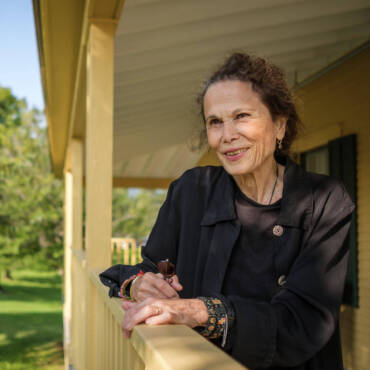
“I Have Blamed Myself Unnecessarily When Things Went Wrong” by Erika Wright
“I dream my own death
My family downstairs—
translucent, spilling light,
watching TV with the volume high.”
“I dream my own death
My family downstairs—
translucent, spilling light,
watching TV with the volume high.”
“Allisa Cherry’s debut collection, An Exodus of Sparks, offers readers a riveting account of faith, loss, and fierce familial love. Using vivid and precise detail, clear syntax, and a diction both biblical and contemporary, Cherry achieves an emotional clarity that sizzles on the page and cuts to the heart.”
“In the city of Hida, there is an
underground mine, dark nest for a stainless
steel observation tank. Deep below sand,
rock, soil: a way to know stars—yes, of course.”
“Climbing through night, I saw the swan
wearing his black Venetian mask
and digging through snow
white plumage”
“His father called me exotic.
I was 17 and flattered;
I wanted to wear that word,
I longed to flatten into it.”
“On our way to the coast, we saw four hawks,
three red-tailed and one red-shouldered. Not aloft, no,
leaning forward, as they do, perched on a wire or a pole
in search of a vole breakfast.”
“I reached out for you this morning. A call
I haven’t made in a long, long time. Not since—
because of course I know—I do… and yet”
“Just back to construction work after time off following my son’s birth, I can tell I don’t have the same patience.”
“The baby’s dragged the sheets to the kitchen, and now she’s stuffing them into the washer.
One hand lifting a wad of yellow cotton,
the other reaching down for more and more.
Breathing heavy, she’s feeding vast swaths by the armful, bent halfway
into the mouth of the machine.
A strip of skin exposed where her shirt’s ridden up.
An edge of diaper sticking out of her pants.
Who can watch a child and not feel fear?”
“The baby’s dragged the sheets to the kitchen, and now she’s stuffing them into the washer.
One hand lifting a wad of yellow cotton,
the other reaching down for more and more.
Breathing heavy, she’s feeding vast swaths by the armful, bent halfway
into the mouth of the machine.
A strip of skin exposed where her shirt’s ridden up.
An edge of diaper sticking out of her pants.
Who can watch a child and not feel fear?”
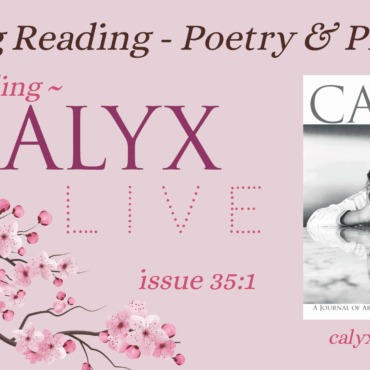
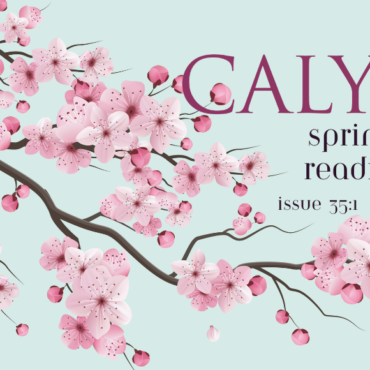
A Chinese nursery song; boxed wine; Soho, 1971; tropical storms named Debby; touching the dead; Kentucky, 1915; discount wedding and groomsmen in purple suits; a nurse named Evangeline and Longfellow’s plodding dactyls, the belt buckle of a dead man; the 1990s and Ross Perot — All this and more in this CALYX Live reading of
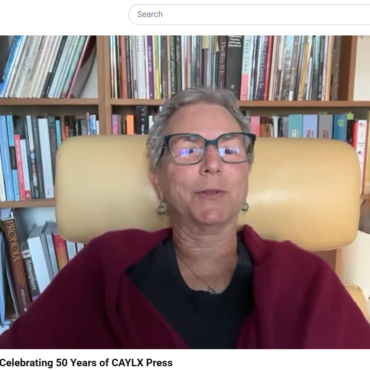
Tuesday, March 24 at 8 p.m. ET / 5 p.m. PT | Join us on Zoom here. Sisterhood in Print: Celebrating 50 Years of CALYX Press! Since 1976, CALYX Press has been a bold, unwavering force in feminist publishing—amplifying the voices of women, including lesbian and queer women—even when doing so meant standing firm in the
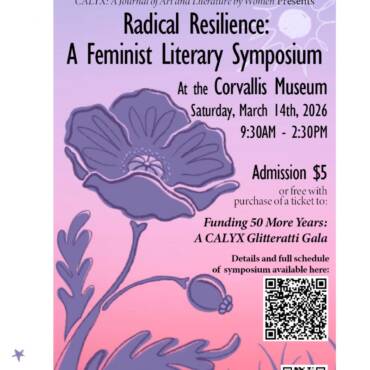
Join us at the Corvallis Museum for a symposium and fundraising gala that celebrate 50 years of art and literature by women and nonbinary creators. CALYX is turning 50! On March 11, 1976, four women writers and artists created a platform specifically designed to spotlight the voices of marginalized creators. CALYX Press has been the
“The bride and groom grinned the way we did then, “The hash has been hand pressed with tea
into little cakes,
then heated over coals
by the gardener in the backyard
of your hotel in Kabul.”
with a mouth full of promise,
believing that even when it finally got dark,
our hearts would glow fluorescent,
for we had stopped the world from spinning
and would always be together just like this.”
“Elsewhere, a biblical hurricane,
but by me the Tchefuncte is motionless,
a mirror for cypress trees, and the lone chaos
is kids cannonballing for Jesus.”
“On February 28, 1979, I got dressed for another day of sixth grade in my newest blue jeans, a knit sweater, and a red satin coat Mom and I had found at Second Act used clothing. I loved that shiny red coat with the wide buckle, but I never wore any of those things again.
Coming home from school, I’d left the 6 far down the platform on the first warm, spring-is-coming day. I felt good. It hadn’t been long since Lindsay had stopped taking me, and it was the very first trip where I felt I can do this! This is my neighborhood, and I belong here, too!
I got off that train and made the mistake of letting my good mood show. I accidentally smiled at a boy on the platform. (Stupid! I’d believe afterwards. You never ever smile.)”
“My mother turned to me and said,
look, his skin is so soft, touch him,
and she held his hand, stroked it
in a way I’d never seen her do in life.”
“The bride and groom grinned the way we did then,
with a mouth full of promise,
believing that even when it finally got dark,
our hearts would glow fluorescent,
for we had stopped the world from spinning
and would always be together just like this.”
“God is a little girl with mud on her hands. She crafts the soft skull of an infant from the earth, cradles it into a face, thumbs settling into eye sockets, an index finger smoothing the angles of a triangle nose. A stick descends from the heavens to carve a mouth, to pierce nostrils and pupils. The mud baby is born, the size of two fists. It lies limp in the girl’s hands, the red clay staining her skin. Creation is messy. The girl wipes the mess away on her dress, but the red remains.”

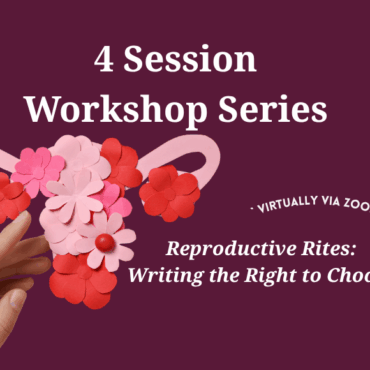
Reproductive Rites: Writing the Right to Choose – A Series of 4 Generative Writing Workshops Presented on Zoom by CALYX Press, Facilitated by Laura Rosenthal This series of four generative writing workshops and a final group reading will support participants interested in writing about reproductive choices and experiences, regardless of genre. We invite both experienced
Burning Down the Haunted House (Trope): How Architecture Amplifies Horror: Craft Talk *** NEW DATE October 24, 2025 *** Virtual (Zoom)COST: $40 This 75-minute craft talk explores how architectural elements in literature reflect and intensify horror, tracing a path from Poe’s “The Fall of the House of Usher” to contemporary works like “In the Dream House” and “Model
Photo credit: OSU CLA photographer, Blake Brown. Balancing academic deadlines, work responsibilities, and a personal life is no small feat for a college student. Yet during her undergraduate years at Oregon State University, Tayah Kohler not only kept pace—she distinguished herself. Through a funded internship with CALYX Press, a historic feminist publishing house based in
CALYX is excited to feature an exploratory new interview with novelist Jean Hegland. Hegland’s new novel, Here in This Next New Now, a companion book to her 1996 debut, Into the Forest, has been released in France. Debbra Palmer’s interview with Hegland covers a wide range of topics, including dystopian themes, fire, taboo, community, gender,
“they sent me flowers
the summer you died
as if more death was a consolation—”
Our very first CALYX Live reading brought the powerful voices of women writers off the page and into the Zoom room—and we’re still glowing. To everyone who joined us: thank you. Your presence, your listening, your applause—it meant everything. To our readers: your words lit the room with courage, truth, and artistry. You reminded us
“Girl-shaped things guzzle Sylvia Plath
SlimFast shakes for breakfast
eat their own fingernails for lunch”
“On the walk home redwings shrill as you hum the “Bogoró ditse” (sixth movement, “Rejoice, O Virgin”), which starts in a slow, solemn whisper and then soars into an exalted alto duet. You would love to sing that duet, but Fred will recruit professionals. You altos joke that Rachmaninoff must have had an alto mistress, because the Vespers gives all the gorgeous melodies to them. The sopranos, who normally get all the gorgeous melodies, joke that they don’t mind being your accessories, but they do.
You tie your raincoat around your waist. The sticky things pull, which makes you hunch over, which makes you think about old age. A rare sunny day in a birdy wetland—at least you’ll be able to do this when you’re old. You think, I suppose it’s time to think about death.
And that’s enough of that.”
“Once, I was my brother’s subject. He controlled
time, light moving across
my face in steady increments”
“This morning I watched a kinglet
—a bird so quick it often evades
human gaze—flit only a foot
from my husband’s face. I watched
the corners of his eyes lift.”
“Jerry is curled around the steering wheel, his head pivoting back and forth as he contemplates passing. He edges closer and closer to the truck’s rear bumper, when an errant rock dislodges from behind its left mudflap. The rock hits their windshield like spit in the face. “Motherfucker,” Jerry mutters. To Miriam, it looks like practically nothing, just a faint indent in the glass, but she knows that by tomorrow it will have spread across the windshield. Somebody will have to repair it.”
“Dark still. Her father loads her arms with bottles of the Jersey’s milk,
and wordless, turns her out under the stern Iowa stars.
She is hardly taller than the snowdrifts.
Stocking-capped head down, she sets out to meet the disapproving wind.”
“The speaker of the poem, “V. Simon the Cyrene,” admits, On all sides I am jostled / by witnesses of an execution. / They say the man had a knife / and the guards shot him down. Drawing poetic (if sobering) parallels between the Nazarene and the dead man (both killed by the state), Watson experiences painful realities that probably more closely resemble those of marginalized communities in first-century Jerusalem than the canonical Gospels portray.”
“Dark still. Her father loads her arms with bottles of the Jersey’s milk,
and wordless, turns her out under the stern Iowa stars.
She is hardly taller than the snowdrifts.
Stocking-capped head down, she sets out to meet the disapproving wind.”
“Say you thought you were pregnant. But you’re eighteen, newbie freshman on campus, hours from your boyfriend, hours from home. Wise enough to bring a couple of pregnancy tests with you to school, ones you made the boyfriend purchase at a drugstore miles from your hometown because, you know, people talk. But this is 1979, and those tests don’t work until you’re a few weeks along. It’s not like today, where you blink and find out you’re pregnant before you even miss a period. If you’re retro enough to still be menstruating.”
“The speaker of the poem, “V. Simon the Cyrene,” admits, On all sides I am jostled / by witnesses of an execution. / They say the man had a knife / and the guards shot him down. Drawing poetic (if sobering) parallels between the Nazarene and the dead man (both killed by the state), Watson experiences painful realities that probably more closely resemble those of marginalized communities in first-century Jerusalem than the canonical Gospels portray.”
“I never thought I’d leave
until I realized it was okay
if he only remembered me as a weight.”
“Gauging others’ happiness by her own preference for company, Will’s mom took Will’s introversion for depression. Her mom always nudged her to make friends. Meet boys. Make boyfriends. Will wondered if teen pregnancy would’ve set her mom at ease, convinced her of Will’s joie de vivre and put to rest her insistence on the pixie cut.”
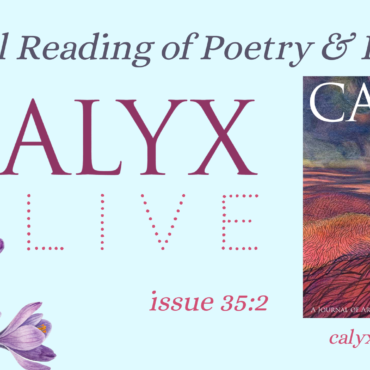
Wednesday, April 16th – 5:30 p.m. Pacific time – Register now to receive the event link and updates Join us for a free virtual reading featuring poets and prose writers from the latest issue of CALYX Journal as they bring their words to life. This is a time to gather, to listen, and to celebrate
Thursday, May 15th – Zoom5:30-7:00 pm Pacific – 8:30-10:00 pm Eastern———->>> Zoom Registration – This is a free event <<<———- Join us for an insightful panel discussion exploring the resilience, creativity, and necessity of women’s voices in times that challenge artists and writers. New York Times Best Selling Author, Eula Biss, is the author of
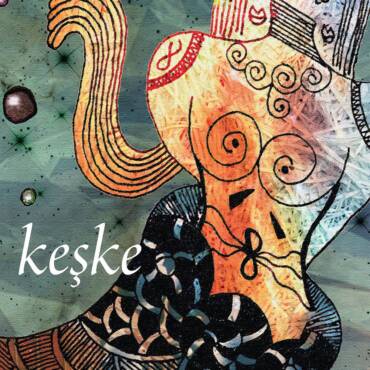
CALYX is excited to feature an immersive new interview with poet Jennifer A. Reimer by Piotr Gwiazda. Reimer’s new collection, Keşke (Airlie Press, 2022), features poems that are, in Gwiazda’s words, formally inventive, often dialogic if not multivoiced, working with lyric and epic traditions. His interview with Reimer covers her experiences in Turkey, the modern retelling
CALYX Press has decided to leave Twitter X and make the move to BlueSky, a rapidly growing social platform. As a feminist press that has been publishing works of literature by women, trans, and non-binary writers for over 50 years, CALYX has always valued creating spaces for dialogue, connection, and inspiration. The decision to shift
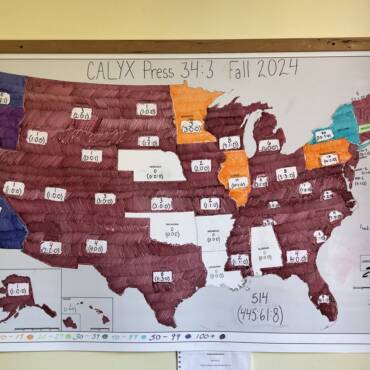
Last month, CALYX Journal hit a major milestone that we’ve been working toward for years: we now have subscribers in all 50 states! This achievement became official in December 2024, when we welcomed readers from Louisiana, Alabama, Arkansas, Nebraska, and Oklahoma—the final states to join our community of supporters. Reaching every corner of the country
“Each page I turn arouses memories,
ghosts mustering in my tiny office,
bumping each other and crowding me”
“The doctor hisses a small yesss
that lingers and I see a bird,
worm in its grasp, the body
in and out of the earth,
except it’s my leg and my vein
and I should look but I’m learning
I don’t always have to.”
“Throughout the jiggling trip, stopping and starting, grumbling motor, people getting on and off, trees and ocean whizzing by, I ignore it all to administer the silent treatment to Nick. He’s acting like he doesn’t notice the thousand cuts from my icy glares, but he’ll find out I’m not playing. Today I’m returning Nick to his parents.”
“there was much
steepling of hands
as if the surgeons
were trying to build
a church to house
their inoperable religion”
“Anna to the left
and Anna to the right,
wild mice,
two halves of an apple.
Now it is time to make a wish:
May this be our last visit here.”
“I have the same disease my family does.
I try to tell stories to make things right.
I keep trying to tell our stories right
because I want to understand our past.”
“Poetry never saved anyone from death, though it might have helped a few to go on living.”
“It’s almost September again.
I sit stiffening in the wide
wicker chair, watching
my line break while late summer folds
the garden like a spent libretto, edges
shredded to a slatternly fringe.”
“Fleshy apples cave as winter arrives early
one October afternoon.
Even the cranes gorging
their hard corn in the fields
seem bewildered.”
“It all starts, Margaret will see later, with the old voicemail that plays through her earbuds on the train to work one morning in the first September Cara is gone. In that moment Cara begins to be resurrected, meticulously pruned, like a bonsai. I have some exciting news, she says, not really Cara but only the captured sound waves that are all that’s left of her by then. I need to tell you about it. And I want to hear what’s up with you. Okay, love you. Call me.”
“My father’s ashes
sit on a bookcase,
waiting for a promised trip
to San Francisco,
where he spent the
best years
of his life.”
“There are worse fates.
At least we didn’t end up
as some nacreous gimcrack souvenir:
‘Greetings From San Fran’ in mother-of-pearl.”
“I read this collection shortly after the sudden death of one of my best friends. I picked it up, even though I didn’t feel any spark for art. I started reading in the bath. Then I was on the bathroom floor, water cold, a little shocked to return to myself in human form, holding a book.”
“If I could just get one thing done
If I could set the to do list on fire
If I could create a clearing
I might hear the Japanese maple outside the window
whispering in stillness and light”
“We leave in a respected line
wearing red:
We’ve been sent good weather,
orange fish that flip over beneath the bridge,
a building of rust-colored brick that you exit as if from your body.
You can’t have everything.
No one has everything.”
Rare is the child, or adult for that matter, who doesn’t wonder what it would be like to lose a sense. I was six or seven the first time I wondered—lying on my stomach in the front yard of our house in San Mateo, the grass cool, prickling against my bare belly, the light stippling through the leaves of the elms that ringed our yard and round a circle of children, siblings and friends, heads close together, whispering,
“What would you rather be: deaf or blind?”
“he needs
to quit drinking before he dies
of it. He says he hasn’t driven
in nine months, that he’s been
losing friends and took today
off work to get his act together.
I ask how he plans to stop
and he says he’s just going to.”
“Beyond the windows the sun was buckling off paving stones, off shutters and white-painted walls, and even in here where the air was antiseptic and cool we talked slowly, moved slowly, cleaned wounds and took blood slowly. It had been long enough since the door had opened that we paused at the squeal of its hinges, noticed the parched breath of the desert sweep in.”
“Woman Pissing takes Picasso’s bravado-soaked declaratives and subjects those claims to a bloodletting. Cooperman’s narrator invokes Julian Barnes’ assertion that Picasso dramatically simplified art. One page later Cooperman demonstrates thus: Because Bonnard kept watching the sky, it became a dozen different colors. / How hilarious that Bonnard cannot paint a sky blue! thought Picasso.”
“You are two and each day is a world
in which to peel gold pawpaw leaves
from the path; to plunk pebbles
in water, one by one; to trace tar
ribbons on cement in watermelon
rainboots”
“My mother hangs up
in the midst of conversation
without saying good-bye.
Her father fled Germany
to secure family passage
eventually. “
“What if mourning is my engine? Sound almost muted, just a whir, behind the T-shirt and jeans. My hands do what is expected—wash dishes, answer emails—instead of reaching down to thump on the dirt or dig.”
“And afterward, we’ll say
it was good, how much we
like how it feels, as our hands
rub the back of our heads.
Then we’ll embrace, relishing
the feel of one another.”
“When you open the door to Toni Morrison, the book begins, you look genius in the face. The multiple facets of the phrase open the door are characteristic of the linguistic dexterity Verdelle and Morrison enjoyed. Over two-and-a-half decades, Verdelle literally opened the door to Toni Morrison many times, a surprising development in Verdelle’s life as a young novelist, and her memoir figuratively opens the door on Morrison as a writer, mentor, and friend.”
Forgive me if the books I might have written linger like a miscarriage.
That word—as in miscarriage of justice—and what is justice now
that the surprise quickening of my youngest might have felt
less blessing than sentence. I had a choice, and still somedays
I lament the sentence I’ve been given and not given.
“A friend texts to ask for ways to keep
her four-month-old occupied
during “tummy time”—a sweet name for the exercise
that will prevent her child from wearing
a helmet while the now-doughy skull forms:
an assortment of dry beans in a plastic bag”
“I’m with you tonight at the candlelight
service in my new straw hat, Mary Janes,
white gloves, a dress that you’ve sewn,
the whole congregation holding candles
at midnight.”
“I hear it before I see a mass of gulls
dive-bombing the channel at the foot
of the falls, where a dark smear
roils like a storm cloud underwater.”
“For her to have achieved more renown, I wonder if Gus would have had to be more pushy, more self-centered, more sure of herself. Or maybe she just needed to have been born a hundred years later. But she was herself, in her own time. My mother, who was a writer, had to make similar choices in her life. And I have too, trying, not always gracefully, to balance being married, having a child, and making a living with the commitment to a creative life.”
“prayer beads and a well and cow dung and smoke and coal and flag plastered on a hill and olive trees and olive trees choiring and an olive seed smacked onto a plate by my grandmother and sheepish eye and a rug in the bedroom from Bulgaria and yogurt fermenting and ashtray with a stomach full of ash and cevşen read thrice and halo of television and plastic covered couches and kahvehane and kahve and Müslüm Baba hunkering hangimiz sevmedik? on taxi radio and Atatürk street and my uncle looping a rope around the awning as a swing for me and kittens and chickpeas and chickpeas dried and collected in a pile and chickpeas on fire”
“What
to do on that unexceptional Sunday, our kids already swim-suited
and seat-belted, but go on, go on, and drive to Door County.
The rest of the ride silent except for my sounds, no one sure
if they’re allowed to have fun until they’re finally loosed
to the shadow-sharp air, their calls and accidental laughter
high as the wind-buoyed gulls.”
“The aches in your back spread in springtime,
breaths caught in each twist. What have I
been? you must ask me. The sheen in
your eyes stolen by dark, it punches
circles onto bone maps, on pelvis,
ribs. I will write you, I offer.”
Friday, April 19: 5-7pm The Benton County Historical Society is hosting an opening reception for artist Betty LaDuke’s newest exhibit, Bringing the World Together at the Philomath Museum (1101 Main Street Philomath, Oregon). LaDuke will give a short talk about her work at 6pm. LaDuke’s current exhibitions focus on social justice from multiple perspectives, with
Katey Schultz speaks at the Corvallis Museum March 9th, 2024, on the topic of research’s role in the creative process.
“The time I’d planned to hike the rim to rim to rim of the Grand Canyon with three athletic friends—all non-menstruating fellows—only to wake at four AM and find myself bleeding and no protection (it was way too early, but you know it kind of shows up when it wants anyway), and one of their girlfriends, who wasn’t hiking with us, when I whispered to her, only had a slender regular. A. Slender. Regular. Right. Which I took, of course.”
“Try to remember the actual
moon is never less than full.
The evening cashier has a secret
sorrow and plans for the weekend.”
“In these years of unrelenting
loss, I have practiced restoration
with you.”
“Dear eyes
like breaking stars,
some days I hear your voice
in the trees, some nights
I send you half my dreams.”
“Sometimes death
takes you by the throat, like burning leaves choke
and ochre light hangs thick as draperies across your living
room window where a slice of sky slips through
to remind you get outside, take a walk, breathe.”
“I thought it was just opening, he says. I thought
the petals were just unfurling.”
“Dress you
as you prefer, in men’s clothes—no rush
or pressure, pleasure in the long look,
the urge for color, then touch—”
“Tonight, I am going to push
the Susquehanna away with my body,
ignore the waning moon’s fractioning
of light.”
“That afternoon, I pretended
to be a cat—tabby, kinked tail.
And the finches behaved
accordingly.”
“Still awake believing our silence might leave us,
desperately needing to make ourselves heard,
every girl told a story before parents came for us.”
“Frida’s Boots beats too with life and determination. In many of Robbins’ poems there is an appreciation for the moment at hand, the pleasure in the everyday experiences, and the heightened awareness that it is all temporary.”
“I imagined us drinking tea
sugared with honesty,
laughing till we turned soft
as fallen apples.”
“Always, I begin
with nothing and too much
to say.”
“Some days
almost everything’s about sex, and maybe
this as well: groan of old boards, joists
and beams remembering, music
of breaking glass.”
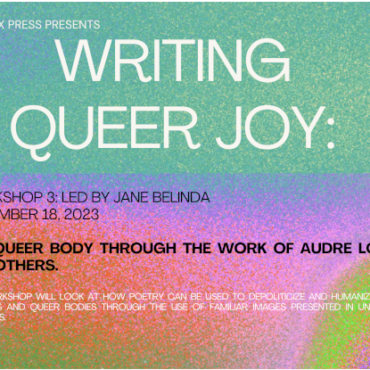
The third entry in the Writing Queer Joy Workshop, an online series presented by CALYX Press.
“Then, when the black nightingale returns to the forest,
when the audacious sun is high,
I wonder, beneath the waves,
where a few more wing beats would have taken me”
“I remember your scarf wrapped twice
around my neck on the Central Line I held my swollen stomach
felt first kicks & fresh strawberries we bought already softening”
“Trash-can colored and rusty, it was a car all throat,
all fits and stutters, a guttural language
choked at every breakneck shift of gears,
a devil’s-in-hell kind of loud, so buzz-saw loud
you could feel the fuel catch fire inside it, its inner life burning
with something I was too small to name.”